Key takeaways
- Ship-from-store turns selected retail locations into e-commerce shipping nodes without replacing the central distribution center.
- Success depends on accurate unified inventory, explicit OMS rules, and standardized in-store fulfillment.
- The model primarily improves product availability, proximity to customers, and sell-through of local inventory.
- The main risk is shifting e-commerce complexity to store teams without adequate capacity or operational control.
What is ship-from-store, and when should you use it?
Ship-from-store is an omnichannel fulfillment scenario: an online order is picked at a store that has the inventory and then shipped to the customer. Generix treats it as an orchestrated flow, not simply an instruction sent to a retail location.
Operational definition: online order, store inventory, customer delivery
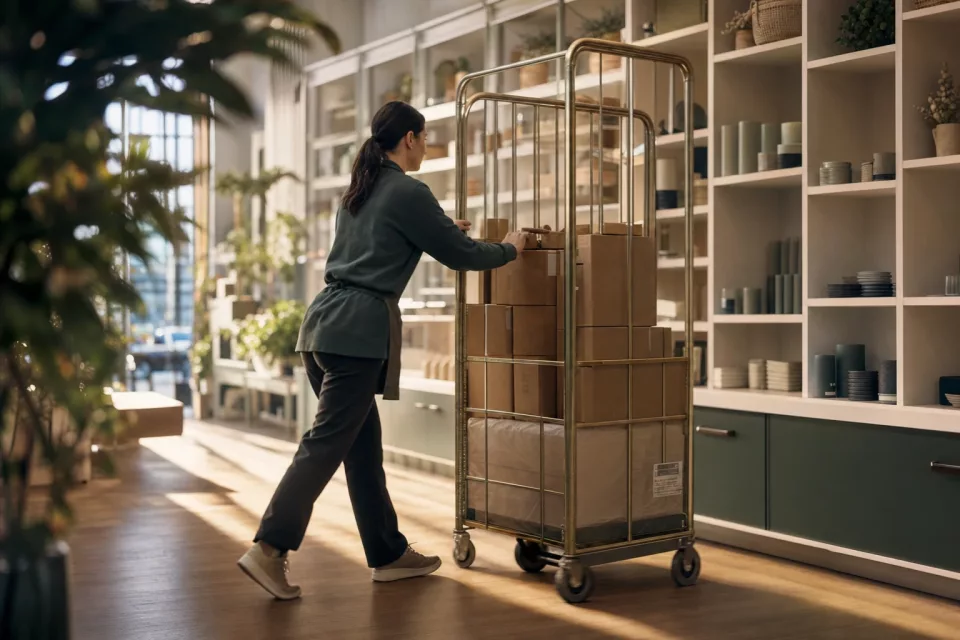
In a ship-from-store flow, the e-commerce site or a store associate promises an available product, the OMS reserves the item at a retail location, and the store team picks, packs, labels, and hands the parcel to a carrier. The store therefore becomes a shipping node while remaining a destination for shopping, customer service, and order pickup.
This model is becoming more important as e-commerce expands across North America. According to the U.S. Census Bureau’s Quarterly Retail E-Commerce Sales, 4th Quarter 2025, U.S. retail e-commerce sales reached US$1,233.7 billion in 2025, up 5.4% year over year. Statistics Canada reported that Canadian retail sales reached C$837.2 billion in 2025, up 4.0%, while seasonally adjusted retail e-commerce sales totaled C$4.3 billion in December and represented 6.1% of retail trade in its Retail trade, December 2025 release. These volumes increase pressure on product availability, delivery promises, and the effective use of store inventory.
For a deeper look at orchestration, see our guide to OMS: its definition, its omnichannel role, and how it differs from WMS and ERP.
How it differs from BOPIS, ship-to-store, endless aisle, and dark stores
Ship-from-store differs from other fulfillment journeys based on where the order is prepared and how it reaches the customer. With buy online, pick up in store—BOPIS, also called click and collect—the customer collects the order at the store. With ship-to-store, the product is moved to the store before pickup. With endless aisle or order in store, an associate places an order for an item that is unavailable locally. A dark store is a dedicated picking facility with no conventional retail activity.
All these scenarios are part of unified commerce: sales channels, inventory, prices, order statuses, and customer information must converge under the same operational control. The difference is therefore not only logistical; it affects the customer experience, store workload, and transportation costs.
Priority use cases: strong store availability, customer proximity, and local inventory clearance
Ship-from-store is relevant when store inventory exceeds local demand, when the customer is near a shipping store, or when the e-commerce distribution center is at capacity. It can also help clear a localized end-of-line assortment, serve a dense urban area, or absorb a seasonal peak.
Generix recommends limiting this scenario to stores that can meet the promise without degrading the in-store customer experience. The operating principle is straightforward: shipping from a store should create value for the network, not move a constraint from a distribution center to a sales team.
What prerequisites should you secure before shipping from stores?
Before enabling ship-from-store, establish three foundations: unified inventory, OMS orchestration, and reliable store execution. Without them, the omnichannel promise can result in cancellations, delays, extra costs, and operational strain across the store network.
Reliable unified inventory: availability, reservations, safety buffers, and exceptions
Unified inventory is the starting point. It consolidates inventory across distribution centers, stores, e-commerce operations, and potentially 3PL providers so the business can display availability that is genuinely sellable. The challenge is not merely knowing theoretical on-hand inventory: reservations, items in fitting rooms, inventory discrepancies, returns not yet released for sale, and safety buffers must all be included.
A store should not ship its last unit when the buffer protects local sales or an order that has already been promised. Conversely, slow-moving inventory should be made visible to the online channel when appropriate. This governance is central to our approach to omnichannel unified inventory.
OMS orchestration: sourcing rules, customer promises, and cost-time-capacity trade-offs
The OMS selects the best fulfillment source using explicit rules: actual availability, distance to the customer, transportation cost, promised delivery time, picking capacity, commercial priority, margin, and cancellation risk. Without an OMS, ship-from-store often becomes a manual process that is difficult to scale and control.
Generix views the OMS as the control tower for omnichannel fulfillment. It does more than choose inventory; it synchronizes the customer promise, reservation, picking, statuses, customer service information, and transportation flows. This coordination among stores, distribution centers, carriers, and customer service teams makes the model reliable.
Store execution: picking, packing, labeling, carrier handoff, and proof of shipment
The store needs a simple, repeatable process: pick list, item scan, quantity check, suitable packaging, label printing, carrier handoff, proof of shipment, and status update. Tasks must fit the store’s operating rhythm, with defined time windows, priorities, and exception procedures.
Training is essential: a sales associate does not work like a distribution center picker, and stores do not always have the space, packing supplies, or equipment required. Generix recommends documenting each task, limiting eligible product categories at launch, and establishing an exception-reporting process during the pilot.
What benefits can you expect from ship-from-store?
Ship-from-store can improve availability, accelerate some deliveries, and generate more value from local inventory. These benefits still depend on the ability to balance customer experience, margin, store workload, and last-mile costs.
Product availability and fewer lost sales
The first benefit is an expanded pool of sellable inventory. If the e-commerce distribution center is out of stock but a store has the item, the order can still be fulfilled. This is particularly important for North American retail networks, where inventory may be spread across urban and suburban stores, regional distribution centers, and e-commerce facilities.
Ship-from-store also improves resilience: selected stores can relieve a distribution center at capacity or support a product category experiencing unusually high demand. To reduce stockouts and uncontrolled substitutions, this logic should be connected to the practices outlined in our article on how to prevent stockouts.
Delivery times and last-mile proximity
Geographic proximity can shorten some delivery times, especially when the store is close to the customer or a carrier pickup location. It does not automatically guarantee a lower cost: the result depends on carrier pickup schedules, order cutoffs, delivery service levels, and parcel density.
The parcel environment makes precise control especially important. Because no single verified North American study provides a market-wide, all-carrier equivalent for both parcel growth and recipient difficulties, operators should measure last-mile performance locally. Shipment volume, on-time delivery, first-attempt success, loss and damage rates, customer contacts, and carrier-level exceptions should confirm that ship-from-store improves the promise rather than adding another point of failure.
Store inventory clearance, fewer markdowns, and better inventory turns
Ship-from-store can create value from inventory held at individual stores: remaining sizes, seasonal items, and products with low local velocity but continued online demand. It then becomes a tool for improving inventory turns and reducing markdowns, provided the commercial gain is compared with picking, packaging, shipping, and return costs.
Generix recommends managing this logic by category and threshold: not every product should be shipped from a store. Bulky, fragile, or packaging-intensive products may remain better suited to a distribution center or dark store.
Comparison table: ship-from-store, e-commerce distribution center, dark store, and BOPIS
The right scenario depends on inventory, lead time, operating capacity, and total landed fulfillment cost. Our approach is to combine models rather than treat stores, distribution centers, and dark stores as competing alternatives.
| Model |
Principle |
Strengths |
Limitations to manage |
Best-fit use case |
| Ship-from-store |
Online order picked in a store and shipped to the customer. |
Uses local inventory, moves selected flows closer to customers, and relieves the distribution center. |
Store workload, inventory accuracy, packaging, carrier pickups, and per-order cost. |
Store networks with accurate inventory and local or regional demand. |
| E-commerce distribution center |
Centralized picking in a facility dedicated to online orders. |
Productivity, quality control, automation, and peak management. |
Distance from customers, capacity constraints, and inventory that may be separated from store stock. |
High volumes, broad assortments, and standardized processes. |
| Dark store |
Picking facility with no conventional in-person retail activity. |
Urban proximity, dedicated operations, and potentially faster fulfillment. |
Real estate costs, geographic coverage, and the need for sufficient order density. |
Dense urban areas with high demand and frequent orders. |
| BOPIS |
Order prepared for customer pickup at a store. |
Store traffic, limited delivery cost, and a connected online-to-store experience. |
Requires customer travel and effective management of queues and reservations. |
Web-to-store journeys and purchases requiring fast pickup. |
For organizations assessing a dark-store model, our experience with the logistics management of a dark store dedicated to e-commerce illustrates the operational differences from a store that is open to the public.
What pitfalls should you avoid during deployment?
Ship-from-store failures rarely come from the concept itself. They usually result from an overly ambitious promise, uncertain inventory, or underestimated store workload. Generix recommends addressing these risks before scaling the program.
Insufficient inventory accuracy: the risk of overpromising and cancellations
Incorrect book inventory creates a poor experience: the order is accepted, the item cannot be found, the order is canceled and refunded, and the customer contacts support. The risk increases when several channels consume the same inventory without real-time reservation.
Controls should therefore be built into the process: safety buffers, automatic exclusion of stores with unstable accuracy, cycle counts, mandatory scans, discrepancy alerts, and substitution rules. The objective is not to sell every theoretically available unit, but to sell inventory the store can actually pick.
Store workload: balancing selling, customer service, and e-commerce picking
Ship-from-store can disrupt a retail location if orders arrive during peak traffic or if fulfillment competes with customer service. Each store needs measured capacity, scheduled picking windows, and an accountable operational owner.
Generix recommends defining a daily capacity for each store, adjustable by day, season, staffing level, and promotional event. The model should also include overflow rules that redirect orders to another store, a distribution center, or a dark store when local capacity is exceeded.
Hidden costs: packaging, transportation, returns, training, and margin control
Ship-from-store is not automatically less expensive. It may shorten a route or save a sale, but it also adds packing supplies, labor, carrier pickups, cross-channel returns, training, and management overhead. Net margin per order should be monitored as closely as conversion rate.
Returns are often underestimated: an item shipped from one store may be returned to another location, requiring quality control, restocking, and status synchronization. Our reverse logistics approach incorporates this complete cycle from the design stage.
How do you deploy ship-from-store step by step through collaboration?
A robust deployment starts small, measures results quickly, and expands progressively. Generix favors a collaborative operating model: the OMS orchestrates, but stores, carriers, distribution centers, and customer service teams share the same statuses and rules.
Deploy in waves: pilot stores, product categories, thresholds, and SLAs
The pilot should combine willing stores, accurate inventory, straightforward product categories, realistic capacity, and stable carrier flows. Start with products that are easy to pick and use standard packaging, with a low risk of claims. Safety buffers protect local sales, while SLAs define preparation time, order cutoffs, and exception rules.
Generix then recommends expanding in waves: add stores, extend product categories, adjust OMS rules, integrate new carriers, and optimize costs. This approach avoids a long, closed implementation cycle and allows operations teams to resolve friction before industrializing the process.
Measure the right KPIs: cancellation rate, OTIF, picking productivity, and cost per order
KPIs should cover the promise, execution, and profitability: displayed availability, successful reservation rate, cancellation rate, preparation time, OTIF, picking productivity, cost per order, error rate, return rate, net margin, and store workload. No single metric is sufficient: a fast delivery rate can conceal deteriorating margins.
North American retail data reinforces the need for structured omnichannel control. The U.S. Census Bureau reported that retail e-commerce sales increased 5.4% in 2025 and represented 16.4% of total U.S. retail sales, compared with 16.1% in 2024, in its Quarterly Retail E-Commerce Sales data. Its Monthly State Retail Sales program provides experimental state-level retail estimates. In Canada, Statistique Canada reported that 2025 retail sales increased 4.0% in value and 2.3% in volume, with monthly tables available by province and territory in Retail trade, December 2025.
Connect the OMS, WMS, TMS, stores, and customer service with Generix Omnichannel Commerce
Ship-from-store becomes truly effective when systems share the same data: the OMS orchestrates orders, the WMS controls distribution center flows, the TMS manages transportation, store applications support execution, and customer service keeps customers informed. This integration eliminates silos and makes the promise visible to every participant.
Generix supports this model with an integrated omnichannel suite designed to connect unified inventory, fulfillment-location assignment, store picking, delivery, pickup, and endless-aisle journeys. This capability is supported by broader supply chain expertise: Generix Group is among the vendors evaluated in the 2026 Gartner Magic Quadrant for Warehouse Management Systems, published April 29, 2026. The report is independent commercial research and should not be interpreted as certification or endorsement.
To define a ship-from-store scenario, we can assess unified-inventory readiness, OMS rules, store workload, and carrier integration. Talk with a Generix expert about orchestrating omnichannel orders from store inventory through customer shipment.
In summary
- Ship-from-store should be enabled only at locations that can fulfill orders without degrading the in-store sales experience.
- The OMS protects the promise by balancing inventory, cost, lead time, capacity, and customer priority.
- Comparing distribution centers, dark stores, BOPIS, and ship-from-store helps select the right scenario for each order.
- A wave-based rollout supported by KPIs prevents stores from becoming improvised distribution centers.