Generix Collaborative Entreprise

« Collaborate to optimise your management and to ensure effective control »

Generix Collaborative Entreprise, an integrated management software package, is designed to model, manage and control all physical and administrative flows (referencing, e-procurements, replenishments, logistics, multi-channel sales, finance) in organizations both simple and sophisticated.

The solution

The solution is available in different packages

  • vertical business solutions designed for:
    - Distribution brands (Major distribution networks, specialist distribution networks)
    - Tele-shopping concerns (mail order, e-trade)
    - Trading companies
    - Logistics operators
  • an enlargeable business software package platform (ProgiClient©)

The solution can be marketed in direct or in SAAS mode (ASP)

Advantages

  • The relevance and wealth of vertical business software and its adequation to company processes
  • The customer's unique vision, whatever their purchase channel (360° vision)
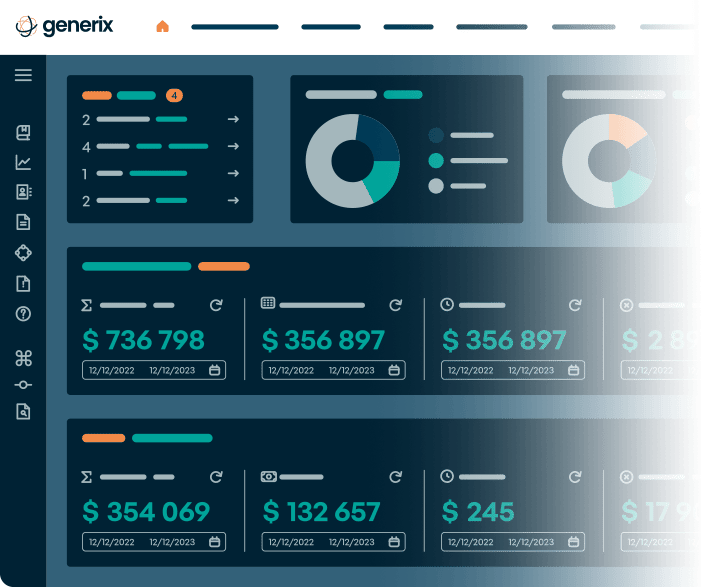
  • The instantaneous provisioning of information to line managers and decision makers whatever its source (milestone monitoring of imports and related activities, stock layout, promotions impacts , replenishments, etc)
  • The high level of parameterization and technology to customize the solution while quickly ensuring its open-endedness at minimum cost
  • Almost unbeatable market competitiveness for the implementation, operation and addition of new functions
Top of the page

Functionalities

1. Enterprise repositories

Vast data repositories (customers, suppliers, third party, franchises, members, products, prices, catalogues, etc.) allow all players (in-house or outside of the company) to contribute to the system and in return have access to reliable, shared datas. The enterprise repository is ideal for all product typologies: either managed by lot (food, conveniences goods, pharmaceutics), multivariants (textiles, shoeware, etc.), or singly (technical products tracked by serial n°, materials, etc.).

Those repositories are then presented to all the group's or company's entities and can be enlarged at all levels of any complex multi-entity structure (e.g.: product repositories at group, national, regional and local level).

2. e-procurement purchases and imports

  • Pricing engines can integrate either simple and complex rules, can take into account commercial cooperation contracts and any other form of contract concluded with suppliers.
  • Purchasing instructions, bid for tenders, orders, delivery requests, goods-in, invoice control and integration in the Finance module are just part of the standard process steps integrated in the solution and complying furthermore with the habilitation rules defined in the system.
  • The implementation of the various purchasing circuits depending on order, product or user typology is performed in line with urbanisation practices using the embedded modelling capabilities of the software.

  • Integration with market places, with other in-house applications or with those outside of the company is facilitated using the communicating capacities of the software package.

  • The depth of import functionalities allows the monitoring of import orders progression, precision calculations of complex and/or multiple cost prices and the implementation of simulations.

3. Assortments and control of retail outlet

  • Network assortments (where retail outlets are integrated in the structure) are provided by dedicated functionalities allowing the offering and the network structure to be segmented. Replenishment orders in line with "push" or "pull" flow systems are proposed by the system depending on estimates or management rules.
  • Retail back office, goods-in, stocks, replenishments, orders, inventories, labelling and price rise functions now back up a wide range of functionalities available to retail outlets in accordance with the format selected by brands (franchises, integrated or mixed formats).
  • The use of mobile terminals in retail outlets provides greater flexibility and reaction capacity.
  • Centralized architecture allows every retail outlet real-time, interface-free access to trading group information and information from the other outlets in the brand network.
  • Local functions can be used (local products, sales operation, customer base, etc.).
  • The agil® suite enables management and coordination of cashing, outlet sales operations, customer loyalty and customer advantage management.

4. Transport and logistics

  • The logistics module, added to purchases and sales functions, is a key tracking component controlling and recording all physical operations involved in the movement of goods within a multi-location storage environment.
  • Reception, checking, storing, shelving, booking, preparation, picking, shipping, transfer and scrapping are logistical operations modelled into the solution.
  • Precise monitoring of lot or serial numbers ensure overall vision of physical tracking and provide real-time data on the position of any batch in the system.
  • The unit allows the level of stocks to be guaranteed at any time but it also allows the latter to be anticipated by offering visions at set time intervals.
  • The system is also designed to select the best haulier matching haulage rate modes and to carry out pre-invoicing for the same.
  • The Generix SCE WMS suite provides control of warehouse operations and resources.
  • The akila® suite optimises up and downstream replenishments.

5. Sales and CRM

  • Generix Collaborative Entreprise is a native software solution aligning with sales channels: sales to general public (retail outlets, mail order, e-trade), quote-based sales to professionals, brand outlets, e-trade, sales via nomad network agents or representatives, subsidiary sales, export, Web sales, etc.
  • Control of sales relations and margins is facilitated by pricing rules modelling taking account of information such as: the sales channel, the catalogue used, typology and source of products, the characteristics of the customer and of the terms of current agreements.
  • Available order scenarios are numerous. Scenarios can be added or customized ad infinitum depending on the various steps of which they are made up.
  • Customer data are available in real time via Intranet or Extranet and allow users to have knowledge in real-time of any customer behaviour within the various distribution channels and to monitor the state of their orders or payments progress.

6. Finance

  • Modelling of the company legal status while taking into account its structure (Group, Company, Public Utility, Franchise Retail Outlet, etc.) allows the automatic addressing of the various financial entities and the native generation of inter-company flows.
  • Analytical structures allow several analytical accounts to be monitored simultaneously with cross axis analyses integrating budget monitoring, commitment monitoring and per job management.
  • Rule input, reminder and payment modules (auxiliary accounts) designed by accountant users and "thought through" to enhance productivity and user comfort are deployed around business screens.
  • The Finance module integrates specialist publishing and distribution functions for financial Information (customer risk, periodic results, budgetary control) and for management purposes (customer statements and reminders, advice of payments to suppliers) either directly by letter, fax, email or as Web html print-outs.
Top of the page

Technical characteristics

  • Full Web solution based on business components (BC4J, XML, Java servlet)
  • Thin client (Internet Explorer 6 or 7)
  • Mobility on PDAs with Windows CE
  • Application server: Oracle Application Server - IBM Websphere - JBoss
  • Database: Oracle 9 and 10
  • Processing server: Linux or Windows
  • Capable of managing large volumes (several hundreds of thousands of command lines daily) and large numbers of users.
  • High capacity of customization of user interfaces. (style sheets, HTML, XSL)